Google rolled out a new default channel inside Google Analytics 4 this spring: AI Assistant. It’s designed to pull traffic from tools like ChatGPT, Gemini, and Claude out of your regular Organic Traffic numbers.
That sounds like exactly the visibility marketers have been asking for since AI search took off. But the update has a significant blind spot that changes what your reports actually mean going forward.
What Changed
On May 13, 2026, Google added AI Assistant as a new option inside the Default Channel Group in GA4’s traffic reporting. Whenever a visit’s referrer header matches a recognized AI assistant, GA4 automatically tags that session with the medium “ai-assistant” and groups it under this new channel.
No manual setup, UTM tagging, or custom regex required. By early June, the feature reached wide availability, and most properties now have it active.
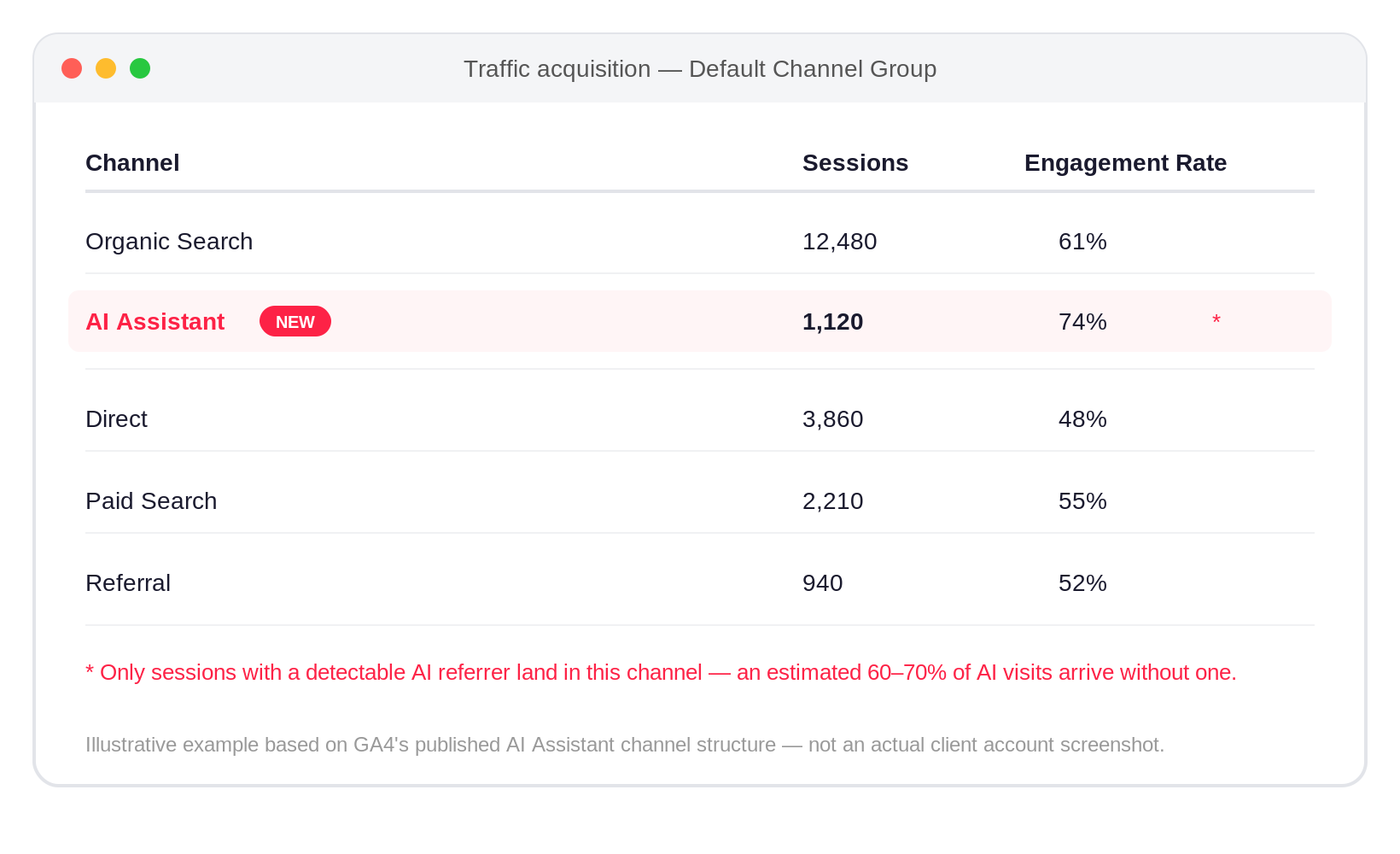
Illustrative example of how the new AI Assistant row appears in GA4’s Traffic acquisition report. Not an actual client account screenshot.
How It Works
The system runs entirely on referrer detection. If someone clicks a link inside an AI chatbot and lands on your site, GA4 recognizes the source and slots that session into the AI Assistant channel automatically.
From there, you can compare AI-referred visitors against organic search, paid search, referral traffic, and direct traffic. That includes metrics like bounce rate, pages per session, and conversions, broken out by channel.
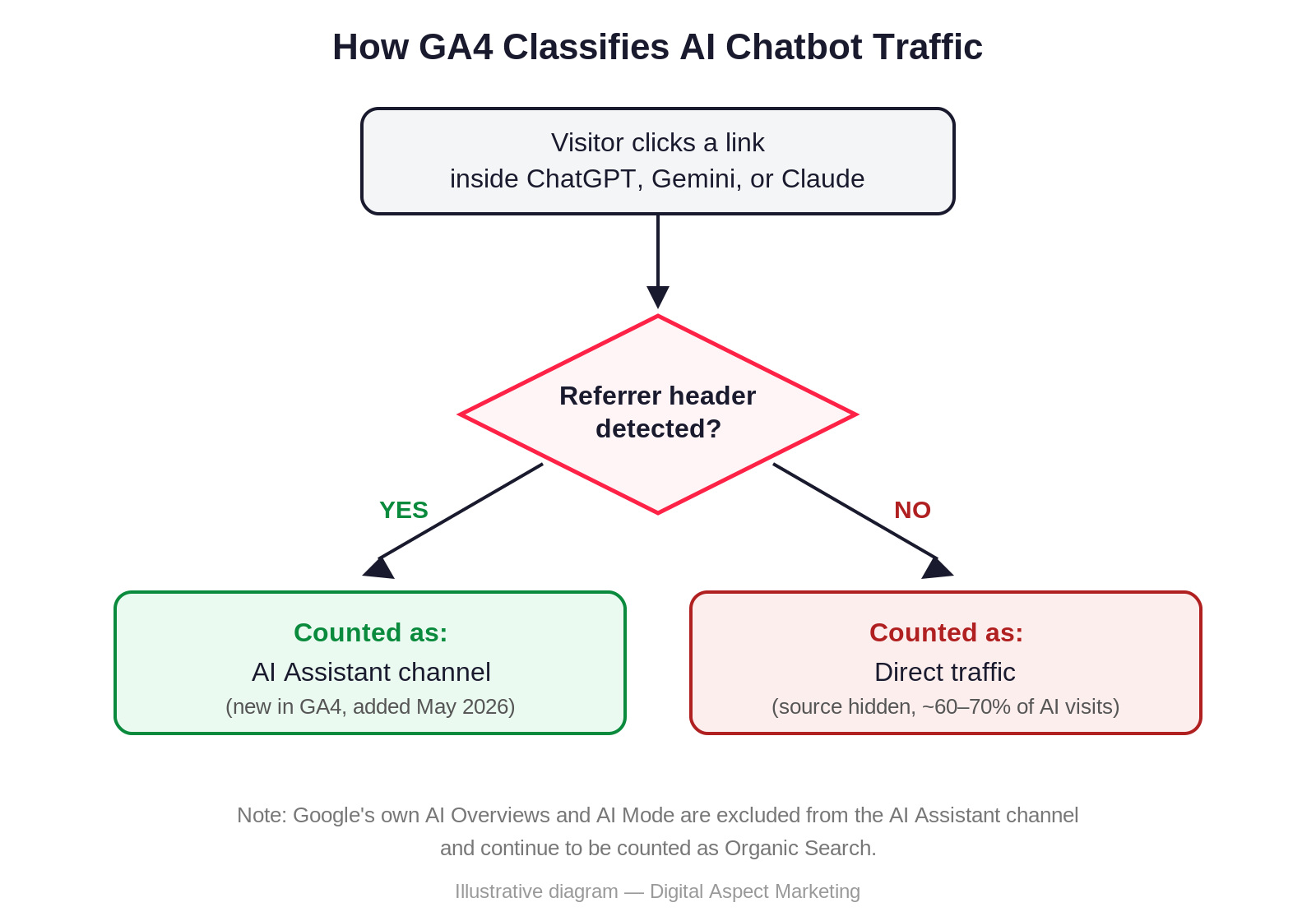
When a referrer header is present, GA4 routes the session into the AI Assistant channel. When it isn’t, the visit lands in Direct instead.
The Catch: AI Overviews Still Hide Inside Organic Search
Here’s where it gets messy. Google’s own AI Overviews and AI Mode, arguably the single biggest AI-driven traffic source for most sites, are explicitly excluded from the new AI Assistant channel. They continue to be counted as ordinary organic search.
That means the channel most likely to matter to your business stays invisible in this new breakdown. On top of that, an estimated 60 to 70 percent of real AI-referred sessions arrive without any referrer data at all, and get bucketed into direct traffic instead.
Here’s what that looks like in practice. Imagine your site normally gets 1,000 organic visitors and 150 visits referred from ChatGPT in a given month. Before this update, those 150 visits would have shown up scattered across Referral or Direct, impossible to isolate.
Now, perhaps 90 of them show up clearly under the new AI Assistant channel. The other 60 still arrive without a detectable referrer and land in Direct, still invisible as AI traffic even with the update in place.
What This Means for Your Reports
Two things worth keeping in mind. First, the AI Assistant channel only counts traffic from the day you enable it forward. It isn’t retroactive, so don’t expect historical AI traffic to suddenly appear.
Second, a rising Organic Traffic number doesn’t necessarily mean traditional search rankings are improving anymore. Some of that growth could be Google’s own AI Overviews sending clicks that are still lumped into the organic bucket, which makes clean attribution harder than it used to be, not easier.
How to Check This Yourself
- In GA4, go to Reports, then Acquisition, then Traffic acquisition.
- Look for the new AI Assistant row inside the Default Channel Group table.
- Compare its trend against Organic Search and Direct traffic over the same period.
- If Direct traffic has grown unexpectedly alongside AI adoption, treat some of that as likely unattributed AI traffic.
Why This Matters
Answer engine optimization only works if you can measure whether it’s working. Right now, GA4’s new channel is a meaningful step forward, but it undercounts the AI traffic that matters most and still buries Google’s own AI-generated answers inside a metric that used to mean something more specific.
Until Google closes that gap, businesses that want an accurate read on their AI visibility need to look at AI Assistant, Organic Search, and Direct together, not any one number on its own.
Final Thoughts
AI is reshaping how people find businesses online, and analytics platforms are still catching up to that reality.
The new AI Assistant channel is a meaningful improvement, but it should be viewed as one piece of your AI visibility strategy rather than a complete measurement solution. Businesses that rely solely on this channel risk underestimating how much influence AI platforms already have on their traffic and conversions.
Pair it with what you already track around Organic Traffic and Attribution, and treat any sudden shifts in either number with a healthy dose of skepticism about where the traffic is really coming from.