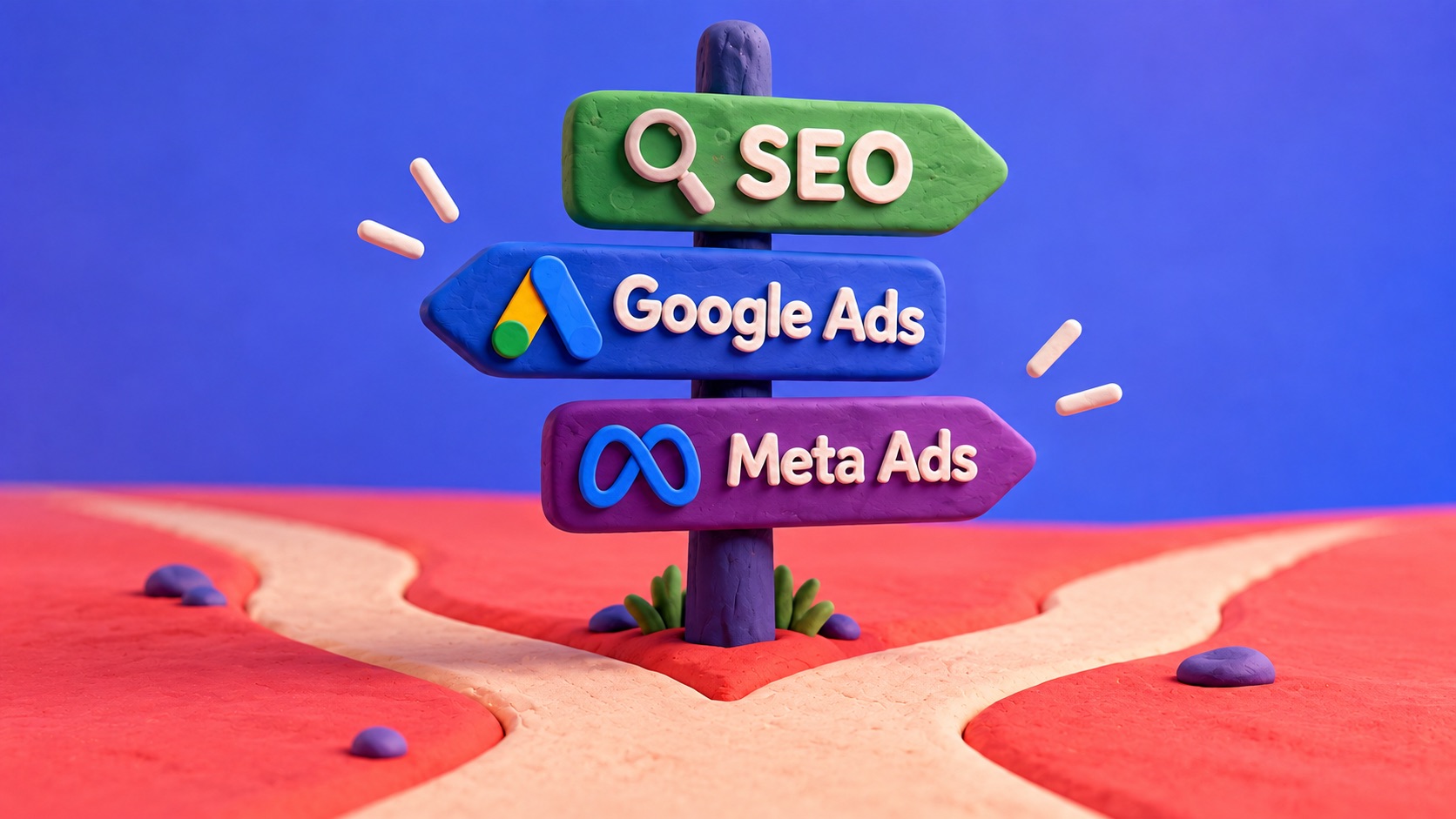
SEO, Google Search Ads and Meta Ads can all generate leads, but they do very different jobs.
The better question is not which channel is universally “best.” It is which channel fits the way your customers actually buy.
A homeowner with a burst pipe behaves very differently from someone planning a $75,000 kitchen remodel. And both behave differently from someone who might be interested in a health coaching program but has never searched for one.
Three factors usually tell us more than the industry alone:
- Are people already searching for what you offer?
- How urgently do they need it?
- How much research and consideration goes into the purchase?
Those answers help determine whether SEO, Google Search Ads, Meta Ads, or more often, some combination of them, makes the most sense.
A note about Google Ads: In this article, when we refer to Google Ads, we are generally talking about Google Search Ads, ads shown to people actively searching for a product or service. Google’s local pay-per-lead advertising options can serve a similar role for eligible local service businesses.
Three Channels, Three Different Jobs
The simplest way to think about these channels is by the job each one performs.
SEO builds organic visibility. It helps your business appear when people search for the services, products and information you provide. It usually takes longer to develop, but strong organic visibility can continue producing traffic without paying for every click.
Google Search Ads capture existing demand. Someone has already decided they need a roofer, plumber, family lawyer or appliance repair company and is actively searching. Search ads let you buy visibility at that moment.
Meta Ads create or stimulate demand. Facebook and Instagram ads can put an offer in front of people who were not actively searching for it. That makes Meta particularly useful for offers that need to be introduced rather than simply found.
The distinction matters because advertising to someone who already wants what you sell is very different from creating interest in someone who was not looking for it.
How Quickly Do They Work?
Paid advertising can begin producing useful signals within days, although it normally takes time to learn which targeting, keywords, offers and creative actually produce profitable customers.
SEO moves more slowly. Initial improvements may appear within weeks, but meaningful organic growth commonly develops over several months and continues to change as rankings, competitors and search behaviour change.
The trade-off is straightforward:
Paid ads can create visibility quickly, but the cost continues as long as you want the traffic. SEO takes longer to build, but successful organic visibility does not carry an incremental charge for every click.
Neither characteristic makes one inherently better than the other.
Budget and Competition Can Change the Answer
Even when Google Search Ads are a strong fit for the way customers buy, the economics still have to work.
High-intent commercial searches tend to attract more advertisers because those searches are closer to a buying decision. More competition generally means a higher cost per click, and costs can vary dramatically by service and market.
Before deciding that Google Search Ads are the right short-term strategy, it helps to look at the estimated cost of appearing near the top of the results for the most important high-intent keywords.
If a realistic monthly budget only buys a handful of those clicks, the campaign may not generate enough opportunities to perform reliably or even provide enough data to judge it fairly.
And a click is only the beginning of the process: Not every click becomes a lead, and not every lead becomes a sale.
That doesn’t mean an expensive keyword is automatically a bad investment. A contractor selling $30,000 projects can afford a very different acquisition cost than a company selling a $150 service call. The important question is whether the expected value of a new customer supports the cost of generating enough qualified leads. If your service or product is recurring, then you should consider the lifetime value of acquiring each new customer.
Google Search Ads capture existing demand, but how practical they are depends on competition, click costs and whether the budget is large enough to generate a meaningful number of opportunities.
High-Cost Services That Require More Consideration
The more expensive the service, the more likely customers are to research providers, compare reviews and consider several options before making a decision. Examples include:
Roof replacement, kitchen and bathroom remodeling, window and siding replacement, major landscaping or hardscape projects, solar installation and HVAC system replacement.
These customers usually research before they buy. They may look at several providers, read reviews, examine project photos, visit websites and compare companies before requesting estimates.
That makes SEO, Google Business Profile visibility and reviews particularly important. The business needs to appear during the research process and give potential customers reasons to put it on their shortlist.
Google Search Ads can complement that strategy by generating quote requests while organic visibility develops or by increasing exposure for especially valuable services.
Meta has a different role here. Before-and-after photos, completed projects, financing offers and attractive transformations can introduce a homeowner to an idea before they are ready to search.
For these businesses, the channels often work together:
Immediate demand: Google Search Ads and local pay-per-lead advertising where appropriate.
Longer-term foundation: SEO, Google Business Profile optimization, reviews and strong service/project content.
Meta: Awareness, inspiration, promotions and remarketing rather than replacing active search demand.
Urgent Local Repair Services
Examples include AC repair, plumbing leaks, electrical repairs, garage door repair, locksmith services and appliance repair.
This customer is behaving very differently.
When an air conditioner dies in August or water is pouring from a pipe, there is very little discovery phase. The customer searches for help and often chooses from the companies that:
- appear prominently
- have strong reviews
- answer the phone
- and can provide service quickly
That makes Google Search Ads and local pay-per-lead placements especially valuable – when the economics and available budget support competing for that traffic.
Meta is generally a poor primary channel for capturing an emergency because the customer is already searching for an immediate solution. Social advertising may still be useful for maintenance plans, replacement services, seasonal promotions or general brand awareness, but it does not replace visibility at the moment someone searches for urgent help.
SEO remains important for exactly the same reason: every lead you earn organically is a lead you did not have to buy one click at a time.
For urgent services:
Immediate demand: Google Search Ads and strong local search visibility.
Longer-term foundation: SEO, Google Business Profile optimization and reviews.
Meta: Usually a supporting role rather than the primary source of emergency leads.
Local Healthcare and Professional Practices
Medical and dental practices, veterinary clinics, chiropractors and similar local providers are often heavily influenced by search and reputation.
A prospective patient may receive a recommendation from a friend and then Google the provider. Or they may simply search for a dentist, chiropractor or veterinarian nearby.
Either way, Google Business Profile strength, reviews, website quality, useful content and organic visibility can all influence the decision.
Google Search Ads can help capture demand for specific treatments, services or new-patient opportunities.
Meta can also work, particularly for elective services, promotions or offers that are visual or need explanation. But it is usually supporting a broader search-and-reputation strategy rather than replacing it.
Coaching, Programs and Offers People Aren’t Searching For Yet
This is where Meta becomes much more interesting.
Consider:
- health and wellness coaching
- webinars
- workshops
- online courses
- consultation offers
- gym or studio introductory programs
People cannot search for an offer they do not know exists.
Someone may never type “online workshop about managing stress” into Google, but the right Facebook or Instagram ad can put that workshop in front of someone who recognizes themselves in the problem being described.
That is demand generation.
Meta can often produce lead volume quickly because the ad introduces the offer and makes responding easy.
But there is a trade-off.
Meta Ads: Fast Lead Volume, but Follow-Up Matters
Someone who searches Google for “emergency plumber near me” has already decided they need a plumber.
Someone who sees a coaching offer while scrolling Facebook may simply think, “That sounds interesting.”
Both can become customers, but they are at very different stages of intent.
Meta lead forms make it easy to submit information, which can lower the cost per lead and increase volume. It can also produce prospects who:
- are still exploring
- do not fully understand the offer
- or are not ready to buy immediately
That makes follow-up extremely important.
Ideally, a Meta lead should move directly into a CRM or follow-up system where:
- the prospect receives a quick response
- the business is notified
- and additional email, text or sales follow-up occurs if needed
A good Meta campaign paired with slow or inconsistent follow-up can look much worse than it really is.
Lead volume by itself is not the goal. Qualified customers and revenue are.
Which Channel Fits Which Business?
| Business or offer | Best immediate lead opportunity | Long-term foundation | Where Meta fits |
| Roofing, remodeling, major landscaping, HVAC replacement | Google Search Ads / local paid placements | SEO + GBP + reviews | Inspiration, project promotion, remarketing |
| AC, plumbing, electrical and other urgent repairs | Google Search Ads / local paid placements | SEO + GBP + reviews | Limited for emergencies; useful for non-emergency offers |
| Medical, dental and veterinary practices | Google Search Ads for specific services | SEO + GBP + reviews | Elective services, promotions and awareness |
| Chiropractic and similar local wellness practices | Google Search + targeted Meta offers | SEO + GBP + reviews | Introductory or educational offers |
| Health and wellness coaching | Meta Ads | Content, referrals, email and SEO | Often a primary acquisition channel |
| Webinars and workshops | Meta Ads | Email audience + content | Strong fit |
| Courses and information products | Meta Ads | Email + content + SEO | Strong fit, usually requiring nurture |
Where Does AI Search Fit?
AI-driven search and recommendation tools are changing how people discover businesses, but they are not really a fourth marketing channel equivalent to Google Ads, Meta or SEO.
Much of the same work that strengthens conventional organic visibility also helps businesses establish the kind of authority AI systems can recognize:
- useful and specific content
- clear expertise
- consistent business information
- strong reviews and reputation
- citations and mentions from other credible sources
- and a website that makes services and expertise easy to understand
For most service businesses, AI visibility belongs inside the broader organic-search and authority strategy, rather than being treated as a separate campaign with a predictable timetable.
A growing share of searchers regularly encounter AI summaries that can answer a question directly on the results page, often with citations to supporting sources. When those summaries appear, users are less likely to click through to individual websites. That makes accurate, useful content that clearly answers real customer questions increasingly important, not only for traditional rankings, but also as part of the broader organic-search and authority strategy that can help a business become a source for AI-generated answers.
So, SEO or Ads?
Usually both, but not necessarily in equal amounts or at the same time.
A new plumbing company may need Google Search Ads immediately because it has little organic visibility.
An established contractor ranking well across its service area may be able to rely more heavily on SEO and use paid search selectively.
A coach launching a program with little existing search demand may get far more immediate traction from Meta than from Google Search.
The right mix depends on how customers actually reach the buying decision.
SEO builds visibility over time.
Google Search Ads put you in front of people already looking for what you sell.
Meta Ads introduce offers to people who may not have been looking at all.
The goal is not to choose a winner. It is to use each channel for the job it is best equipped to do, and measure the results by leads, customers and revenue rather than clicks or traffic alone.
Not sure whether your budget should be going toward SEO, Google Search Ads or Meta Ads right now?
See how Digital Aspect Marketing builds a strategy around your services, customers and market.