Why Bothering With a Recovery Sequence Actually Pays Off
The average online store loses about 70% of its carts before checkout, according to Baymard Institute’s analysis of 50 separate studies on the subject. That number sounds alarming until you remember what it actually represents: someone who liked a product enough to add it to their cart, then got distracted, wanted to compare prices, or decided to wait until payday. Most of that isn’t lost business. It’s business that needs a nudge.
The nudge matters more than people expect. Email marketer Chase Dimond has pointed out that sending a full sequence of abandoned cart emails produces roughly 69% more orders than sending just one reminder. A single “you forgot something” email catches whoever happens to check their inbox at the right moment. A short sequence, timed and spaced out, catches almost everyone else too.
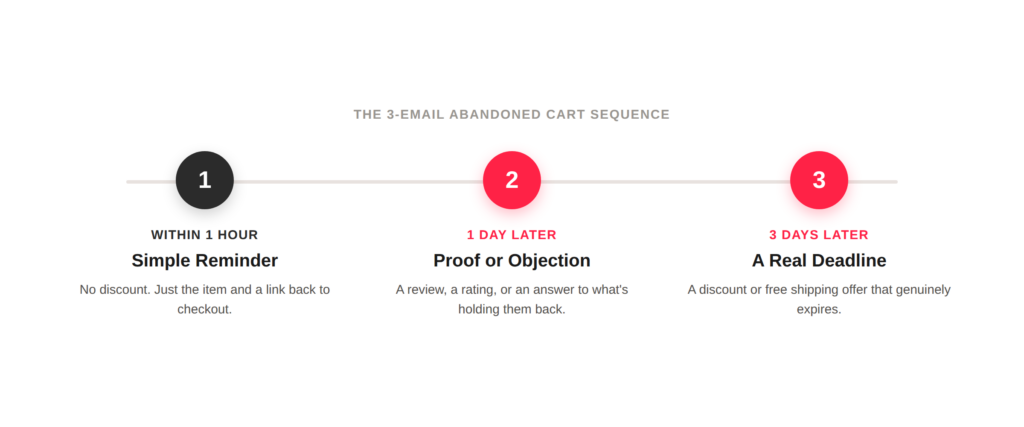
Here’s what each of those three emails should actually say, when to send them, and why the order matters.
Email 1: Send It Within the Hour, Keep It Low-Key
The first email should go out within about an hour of abandonment, while the person still remembers what they were looking at and why. This one isn’t a sales pitch. It’s closer to customer service: a simple reminder that their cart is still sitting there, with a photo of the item and a direct link back to checkout.
Subject lines that work here stay plain and specific, nothing that sounds like it’s trying too hard:
“Still in your cart”
“You left this behind”
“Did checkout give you trouble?”
Skip the discount at this stage. Offering money off in the very first email trains shoppers to abandon their cart on purpose next time, knowing a coupon is coming if they just wait. Right now, the goal is just to remove friction, not add an incentive.
Email 2: One Day Later, Bring In Proof or Answer the Objection
If the first email doesn’t convert, send the second one about 24 hours after the first. This is the point where you address whatever’s actually holding someone back rather than repeating the same reminder. That could mean social proof, like a star rating or a short customer quote, or it could mean answering a specific objection directly: shipping costs, return policy, sizing.
Subject lines can get a little more direct at this stage:
“Here’s what other people are saying about it”
“Free returns, if that’s what’s holding you back”
“Still thinking it over?”
The idea is to give the shopper new information, not just a second reminder of the same thing they already ignored once.
Email 3: Three Days Out, With a Deadline That’s Actually Real
The third and final email goes out around 72 hours after abandonment, and this is the one where a discount or free shipping offer earns its place. By now, a gentle reminder and a little reassurance haven’t worked, so a real incentive is a reasonable next step.
The key word is real. We wrote recently about the psychology behind urgency and scarcity tactics, and the short version applies directly here: a countdown or deadline only works long-term if it’s true. If the “24 hours left” offer is still sitting there next week, customers notice, and it costs more trust than the recovered sale is worth.
Subject lines here can lean into urgency, as long as the deadline behind them is genuine:
“Last chance: 10% off expires tonight”
“Your cart (and this discount) are about to disappear”
Three emails is usually the right stopping point. Past that, most sequences see diminishing returns and a rising unsubscribe rate for the effort involved.
Turning This Into a Workflow Instead of a Manual Task
None of this works if someone on your team has to remember to check for abandoned carts and send these by hand. It needs to run as an automated sequence: triggered the moment a cart is abandoned, timed automatically, and set to stop the moment someone completes their purchase.
We build a version of this for clients who run their CRM and email through Keystone, our white-labeled all-in-one platform. In practice, the whole sequence is a single workflow: it triggers on an abandoned-cart status, waits the right number of hours between each step, and drops out automatically if the customer checks out in the meantime. Since SMS lives in the same platform as email, it’s also easy to add a text nudge alongside that third, time-sensitive email instead of relying on inbox alone. None of that requires switching tools or exporting lists between systems, since it’s already the same place your leads and pipeline live.
The structure works the same way in any email platform with automation built in. The platform matters less than actually having the sequence running in the background instead of living on a to-do list.
Want this set up as an actual automated workflow instead of something you have to remember to do? Get in touch with our team →