If your organic traffic dipped sometime between August 18 and August 21, 2026, you’re not imagining it. Google just finished rolling out its August 2026 spam update, the third one it’s run this year, and it touched sites across every language and region. I’ve been keeping an eye on this one, so here’s what I found.
What a “Spam Update” Actually Is
Google’s automated spam-detection systems, built around its AI-based SpamBrain, run constantly in the background. A “spam update” is what Google calls it when it makes a notable improvement to how those systems work: either sharpening detection of known spam tactics or teaching the system to recognize a new one. It’s a different animal from a core update, which is about how Google ranks and evaluates genuinely good content. Spam updates are specifically about identifying and demoting content that violates Google’s spam policies in the first place.
The August 2026 Rollout, By the Numbers
- Started: Tuesday, August 18, 2026, around 12:30 PM ET.
- Finished: Friday, August 21, 2026, around 4:50 AM ET.
- Duration: Just under 3 days.
- Scope: Google called it “a normal spam update,” applying globally across all languages.
- What it didn’t touch: Google specifically said this update doesn’t address link spam or site reputation abuse. Those are handled by separate, dedicated updates.
Google’s John Mueller also pushed back on chatter that the update had started rolling out earlier than announced, saying that wasn’t the case.
Who Got Hit (and Who Didn’t)
Early reports from site owners and SEOs are a mixed bag, which is typical in the first few days after any spam update:
- Niche specialists lost ground to generalist resellers. Some smaller, subject-matter-expert sites reported being displaced in rankings by larger stores or resellers with far less domain expertise.
- Some publishers got hit hard. A few reported traffic falling off a cliff. One described going from a steady stream of visitors to fewer than 100 every half hour.
- Discover and Google News visibility dropped for some sites, along with slower indexing of new articles: hours instead of minutes.
- Not everyone lost. Some site owners reported the opposite: recovery from rankings issues they believed were false positives from earlier updates.
That split is worth remembering before you assume the worst. A traffic drop the same week as a spam update doesn’t automatically mean Google flagged your site as spam, but it’s the first thing I’d rule out.
2026’s Spam Updates, So Far
This is already the third spam update of the year:
- March 24, 2026: roughly 19.5 hours to roll out.
- June 24, 2026: about 2 days.
- August 18 to 21, 2026: just under 3 days.
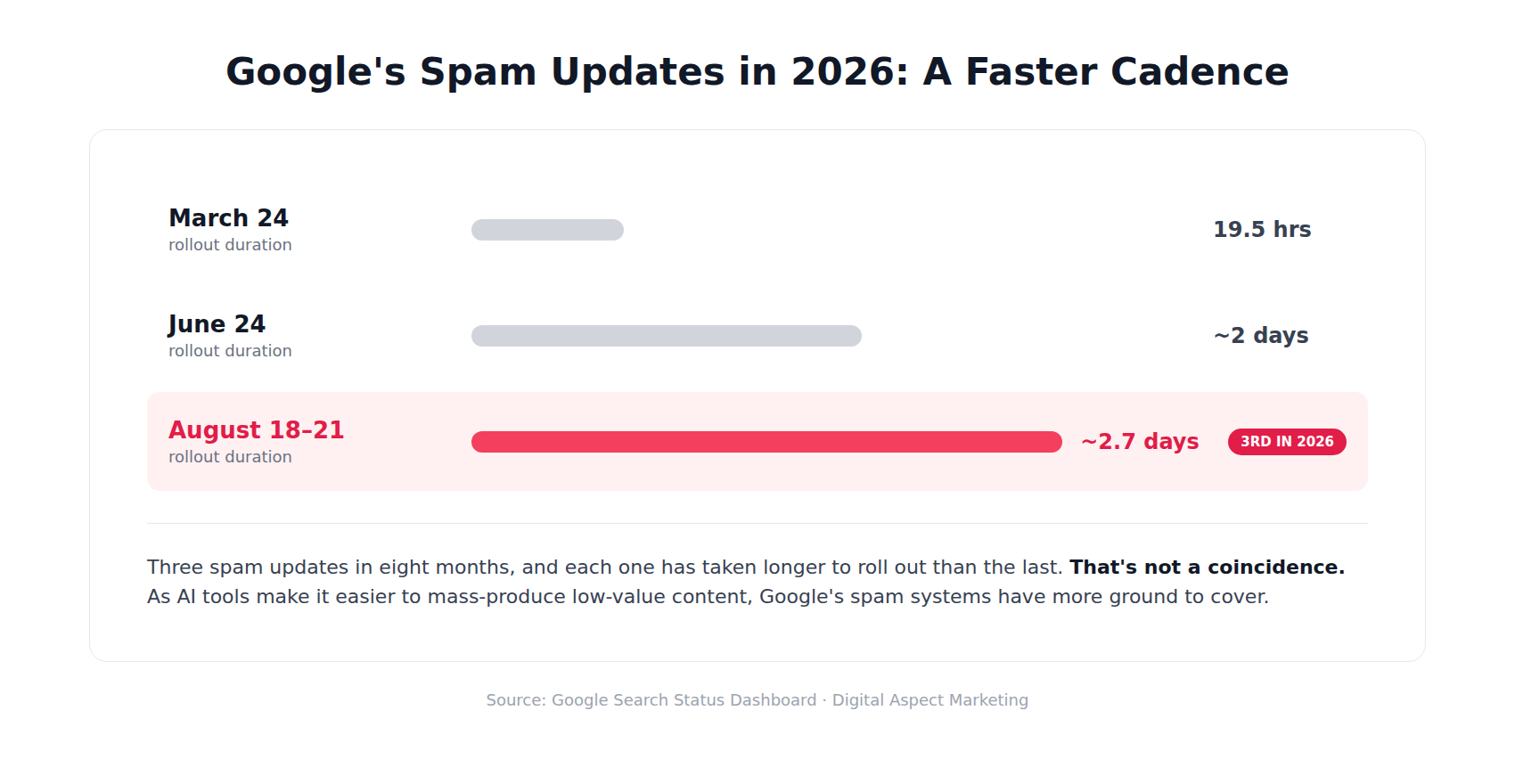
Three spam updates in eight months is a faster cadence than we’ve seen in years past, and I think it’s a sign Google is continuing to invest heavily in cleaning up search results as AI-generated content and scaled content farms get easier to produce.
How to Check If Your Site Was Affected
- Pull up Google Search Console’s Performance report and filter the date range to August 15 to 22, 2026. Look for a sudden drop (or jump) in clicks and impressions right around August 18 to 21.
- Cross-reference against Google’s spam policies rather than guessing. The categories most commonly caught in these updates include scaled content abuse (mass-producing low-value pages, often with AI), thin affiliate content, expired domain abuse, cloaking, doorway pages, hidden text or links, and scraped content.
- Don’t waste time on link cleanup for this one. Since this update explicitly excluded link spam and site reputation abuse, a drop right now is unlikely to be about your backlink profile.
- Set expectations for recovery. If you do find and fix a genuine policy violation, Google says it can take “a period of months” for its systems to recognize the fix and reflect it in rankings, not days or weeks.
Why This Matters
I say this to clients all the time: Google’s baseline expectation hasn’t changed even as the tools for producing content have. Real value for real people, not content built primarily to rank. If your site got swept up in this one and you’re confident you’re not doing anything on that list, document what changed and keep an eye on your Performance report over the next few months rather than making sweeping changes based on one data point.
Not sure whether your traffic dip is this spam update, a core update, or something else entirely? See how our SEO team can help →