Apple Keeps Its Own Products Secret From Almost Everyone, on Purpose
Long before an iPhone ever reaches a store shelf, Apple has already run one of its most effective marketing plays: telling almost nobody anything. Product announcements happen at tightly controlled, invitation-only events limited to journalists, employees, and hand-picked guests, a shift from Apple’s earlier days of presenting at large public trade shows. That secrecy is the whole point. It turns every announcement into an event people actively want to watch, and it’s a big reason these keynotes have historically caused real swings in Apple’s stock price.
Steve Jobs added a theatrical touch on top of the secrecy. He’d wrap up a keynote, start to walk off stage, then turn back around and say “but there’s one more thing,” before revealing the announcement everyone actually came for. It’s a small trick borrowed from TV detective shows, and it worked because the audience had already been told the presentation was over.
This combination of scarcity and showmanship even earned its own nickname inside Apple: the “reality distortion field,” a term coined in 1981 to describe how Jobs could convince a room that something difficult was easy through, as one early Apple engineer put it, “a mix of charm, charisma, bravado, hyperbole, marketing, appeasement and persistence.”
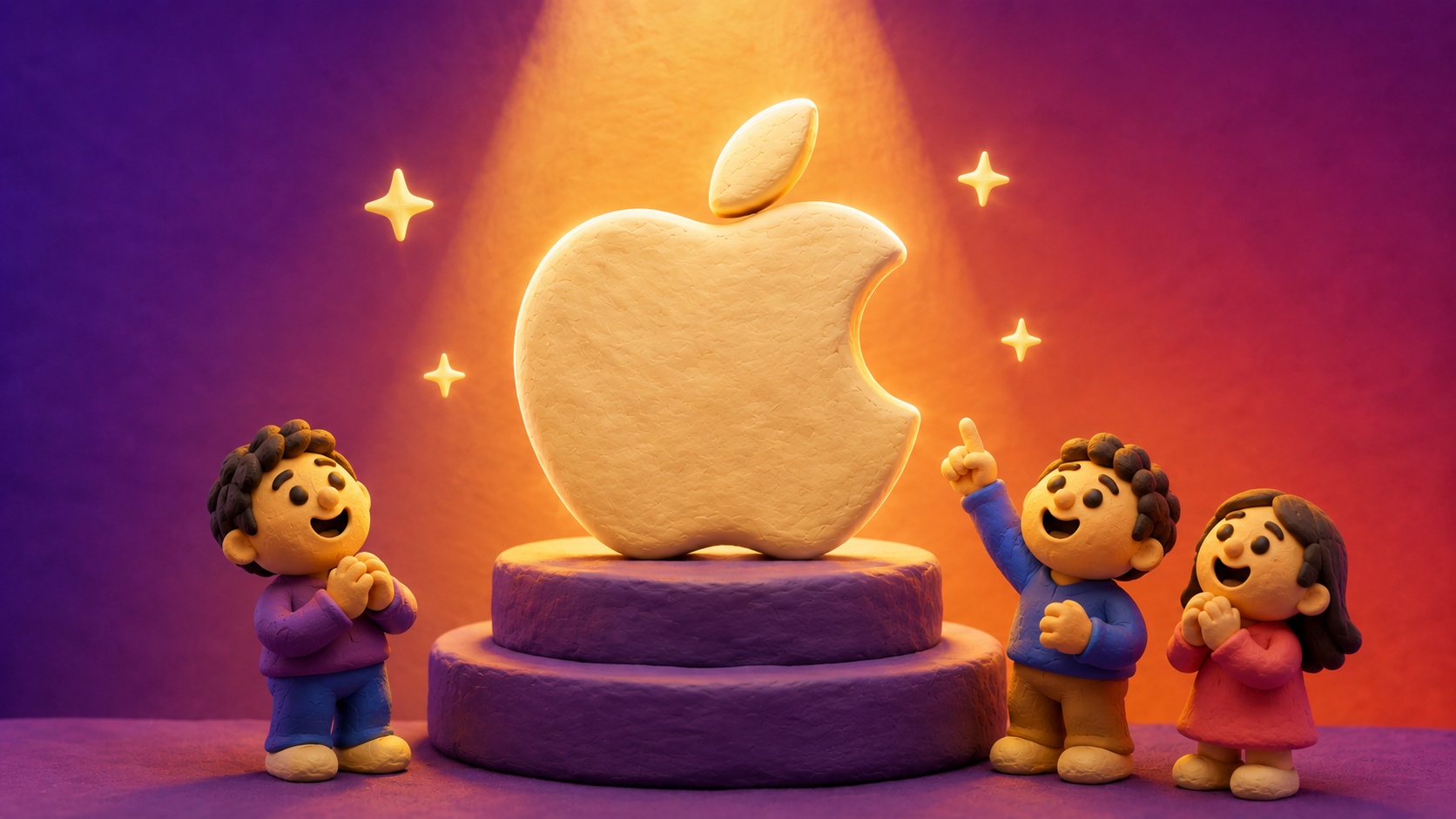
The same pattern shows up on launch day itself. Apple Store openings and new product releases regularly draw crowds of hundreds of people, some camping outside a full day before doors open. That’s not an accident of demand, it’s a visible demonstration of brand loyalty that becomes part of the marketing itself. Every news camera pointed at a line outside an Apple Store is free proof, to everyone watching from home, that the product must be worth wanting.
The Ads Were Never Really About Computers, They Were About Who You Are
In 1997, Apple was in real trouble and needed a campaign to signal a comeback. Steve Jobs rejected the agency’s first pitch, a slogan called “We’re Back,” and pushed for something bigger. What came out of that was “Think Different,” a campaign that ran from 1997 to 2002 and barely mentioned a single Apple product.
Instead, the ads showed black-and-white footage of Einstein, Gandhi, Martin Luther King Jr., John Lennon, and other historical figures, closing on the line that the people “crazy enough to think they can change the world are the ones who do.” Jobs personally called the families of Jim Henson and John F. Kennedy, and visited Yoko Ono, to secure the rights to use their likenesses. A shorter version of the ad even aired during the finale of Seinfeld, one of the most-watched TV events of that era.
The campaign wasn’t just well liked, it was measurably effective: it won the 1998 Emmy for Best Commercial and the 2000 Grand Effie Award for the most effective advertising campaign in the country. The psychology behind it is straightforward once you see it: people don’t just buy products for what they do, they buy products that reflect who they believe they are. Apple wasn’t selling a computer. It was selling a self-image, and letting the computer come along for the ride.
Apple Picked a Villain and Let Customers Cheer Against It
Nothing demonstrates this better than two of Apple’s most famous campaigns, both built around conflict rather than features.
The first is “1984,” directed by Ridley Scott and aired exactly once, during the third quarter of Super Bowl XVIII on January 22, 1984. It shows a dystopian, gray world of marching drones controlled by a Big Brother figure on a giant screen, until a lone athlete hurls a sledgehammer through it. Apple’s own board of directors reportedly hated the ad when they first saw it, but it aired anyway, and it worked: it’s credited with driving an estimated $3.5 million in Macintosh sales in the days that followed, and it’s still regularly ranked as the greatest commercial ever made, decades later.
The second is “Get a Mac,” which ran from 2006 to 2009 and turned the entire PC-versus-Mac comparison into two literal characters: a relaxed, casually dressed “Mac” played by Justin Long, and a stiff, formally dressed “PC” played by John Hodgman. Instead of listing specs, Apple let viewers watch the “cooler” character win, over and over, in 30-second increments. It sold: Apple reported around 200,000 additional Mac sales in the campaign’s first month alone, 1.3 million by that July, and a 39% jump in overall sales for the fiscal year.
Both campaigns lean on the same psychological pull, the pull of an “us versus them” story. Once someone is rooting for a side, they stop evaluating the product feature by feature and start defending an identity instead.
One Breakout Hit Made People Trust Everything Else Apple Made
Here’s a quieter trick, and one that’s harder to notice while it’s happening. When the iPod became a massive hit in the early 2000s, it didn’t just sell more iPods, it made people more willing to trust Apple’s laptops, and later its phones, before those products had proven anything on their own. This is a well-documented pattern called the halo effect: enthusiasm for one product spills over onto a company’s entire lineup.
Part of what fuels that spillover is simple word of mouth. Someone who loved their iPod told friends and family about it, and that goodwill traveled to the Mac and the iPhone long before most of those friends had touched either one. Apple didn’t have to convince a skeptical audience about the iPhone in 2007 from a standing start. A few years of iPod loyalty had already done a good chunk of that work.
The Website Copy Is Written Like a Confident Friend, Not a Spec Sheet
Open Apple’s website today and you won’t find long technical explanations up front. You’ll find short, declarative lines that sound almost like a friend’s opinion rather than a marketing claim: “The thinnest iPhone ever. With the power of pro inside.” “Last phone standing.” “Feature stacked. Value packed.” “Stunning made simple.” “New look. Even more magic.”
Notice what these lines have in common. They’re short, often just sentence fragments. They lean on superlatives (“ever,” “last,” “even more”) instead of numbers. And they use warm, sensory words like “magic,” “delightful,” and “stunning” instead of technical jargon. There’s no hedging, no “may,” no explaining why you should believe it, it’s just stated as settled fact.
That confidence is deliberate. A sentence that sounds completely sure of itself is harder to argue with than one that’s trying to convince you. Readers tend to absorb a confident claim first and question it later, if they question it at all, and Apple’s copywriting is built to take advantage of exactly that instinct.
The Pricing Is Built so the Upgrade Looks Like the Smart Choice
Take a real, current example: the iPhone 17 Pro. Priced out on Apple’s own site, the storage tiers look like this: 256GB for $1,099, 512GB for $1,299, 1TB for $1,499, and 2TB for $1,999. Look closely at the jump from the base model to the next tier up. Doubling the storage, from 256GB to 512GB, costs an extra $200, even though the actual hardware cost of that extra flash storage is a tiny fraction of that.
Here’s why that works. Once someone has already mentally committed to spending $1,099, an additional $200 doesn’t feel like $200 in isolation, it feels like a small percentage on top of a decision they’ve basically already made. That’s a version of a well-known effect called anchoring: the first number you see resets what feels “reasonable” for every price that comes after it. A $200 add-on feels expensive on its own. A $200 add-on framed as an upgrade to a $1,099 purchase can feel like an easy yes.
Not sure how your own brand could build this kind of pull? See how DAM’s branding and logo design services can help →