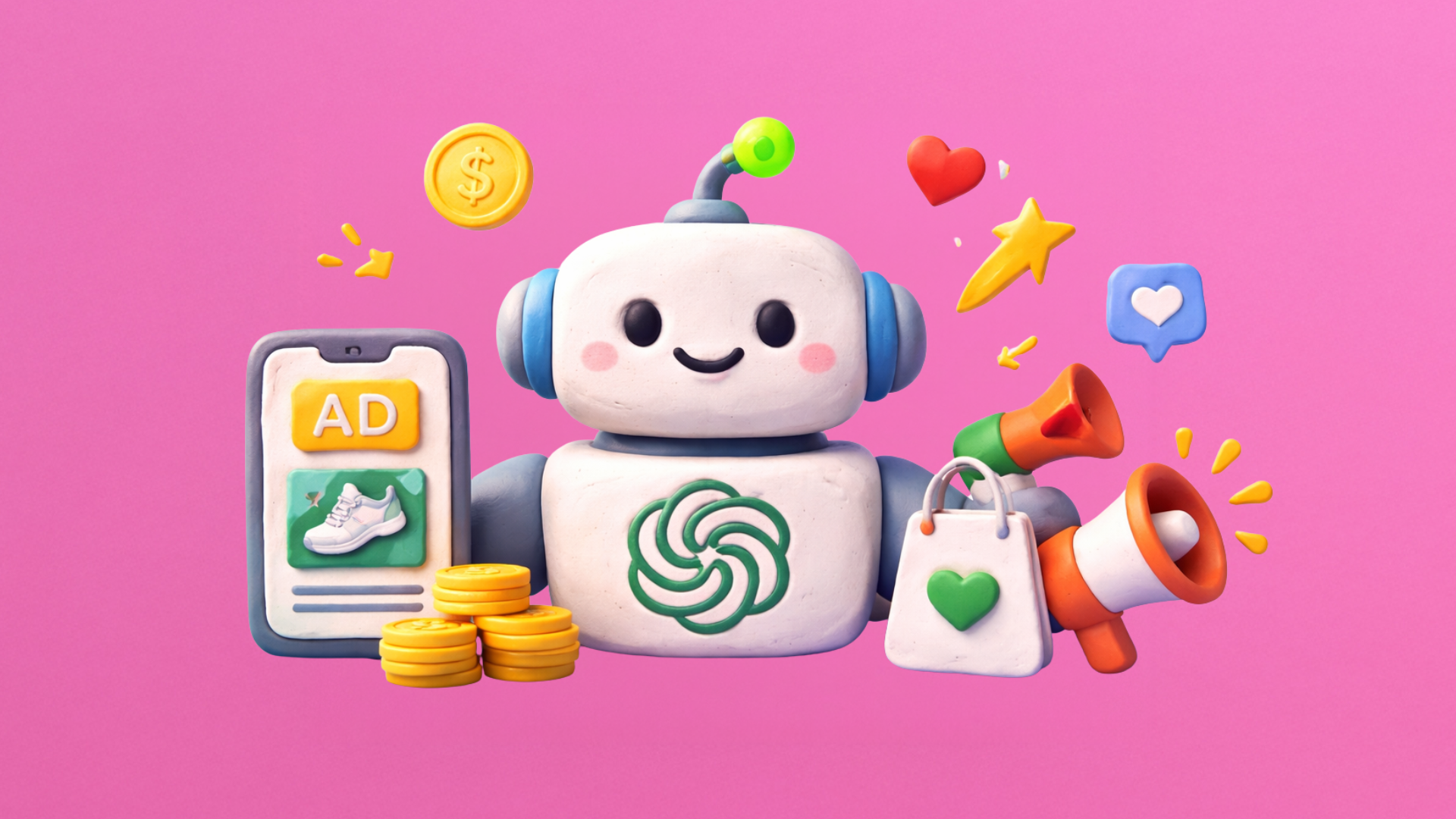
It’s official: ads are coming to ChatGPT!
OpenAI has quietly published a policy outlining plans to test advertising inside ChatGPT, beginning with free users and the new low-cost “Go” tier in the U.S. This isn’t speculation or a leak. It’s a clear signal of where the platform is headed.
While the announcement leans heavily on language around trust, independence, and user choice, the underlying shift is hard to miss. ChatGPT is moving from a neutral AI assistant toward something much bigger: a monetized discovery platform.
What OpenAI Is Promising (So Far)
At least initially, OpenAI is positioning this rollout as measured and user-conscious.
- Ads will appear only for free and Go-tier users.
- Paid tiers (Plus, Pro, Business, Enterprise) will remain ad-free
- Ads will be labeled clearly and placed below AI responses
- Advertisers won’t be able to influence the answers themselves.
- Conversations won’t be sold, and ad personalization can be turned off.
On paper, this feels restrained—almost cautious. But anyone who has watched platforms like Google, Meta, or Amazon evolve knows that early restraint rarely defines the end state.
The Bigger Shift No One Can Ignore
This isn’t really about the ads. It’s about what ChatGPT will look like once the ads exist at all.
With monetization comes a new role. ChatGPT may soon start to function as:
- A contextual recommendation engine
- A top-of-funnel discovery layer
- A gatekeeper between intent and decision
Unlike search engines that present a list of options, AI interfaces deliver a single synthesized answer. When ads appear in that environment—even outside the answer itself—visibility becomes dramatically more concentrated and far more valuable.
Why Marketers Are Paying Very Close Attention
OpenAI maintains that ads won’t affect answers. That may be true in a literal sense—but it misses the strategic reality. In AI-driven experiences, placement often matters more than persuasion. When a user sees a recommended product, service, or brand immediately after the AI resolves their question, the groundwork has already been laid.
That’s what makes this environment so powerful.
- User intent is explicit, not guessed
- Context has already been framed by the AI
- Trust is inherited from the interface
These won’t behave like traditional search or display ads. They’ll feel closer to sanctioned recommendations.
Why Creators and Publishers Should Be Watching Closely
For content creators, this announcement lands in familiar territory. First came AI-generated answers. Then, there were reduced click-throughs. Now monetization is layered directly beneath those answers.
The pattern is clear: information moves upstream, traffic moves downstream, and platforms capture the value in between. If ChatGPT becomes a primary interface for research, comparison, and decision-making—and ads occupy the space adjacent to the answers—organic content risks becoming essential to the system while being increasingly invisible commercially.
The Part OpenAI Isn’t Saying Out Loud</h2>
OpenAI frames ads as a way to expand access. That may be true—but it’s not the whole story.
Ads also:
- Create leverage over discovery
- Establish pricing power around intent
- Turn answers into monetizable real estate
This isn’t a betrayal of user trust. It’s the economic reality of running a high-cost, high-demand AI platform at scale.
The Takeaway
ChatGPT showing ads isn’t a shock—it’s a milestone. It marks the moment conversational AI officially joins search and social as a monetized discovery channel.
For marketers, it opens a new frontier of intent-driven visibility. For creators, it underscores a harder truth: attention increasingly flows through platforms that answer first and monetize second.
The real question isn’t if ads appear. It’s who ends up positioned closest to the answer when they do.